
If you're thinking "I'm not flexible enough" or "I can't sit still that long," you're not alone. Those are the two most common fears beginners bring to their first Yin class — and neither one disqualifies you.
This guide covers what Yin Yoga actually is, what it does for your body and mind, and how to try it for the first time. Spirit Body Yoga's whole-person approach to wellness — body, mind, and spirit — makes gentle practices like Yin a natural part of its online class library, available to complete beginners from day one.
Key Takeaways
- Hold floor-based poses for 3-5 minutes or longer—no flexibility required to start
- Targets connective tissue (fascia, ligaments) instead of muscles to support joint mobility
- Props and modifications make every pose accessible, even on your first try
- Pairs well with active styles like Vinyasa, filling the recovery gap most routines miss
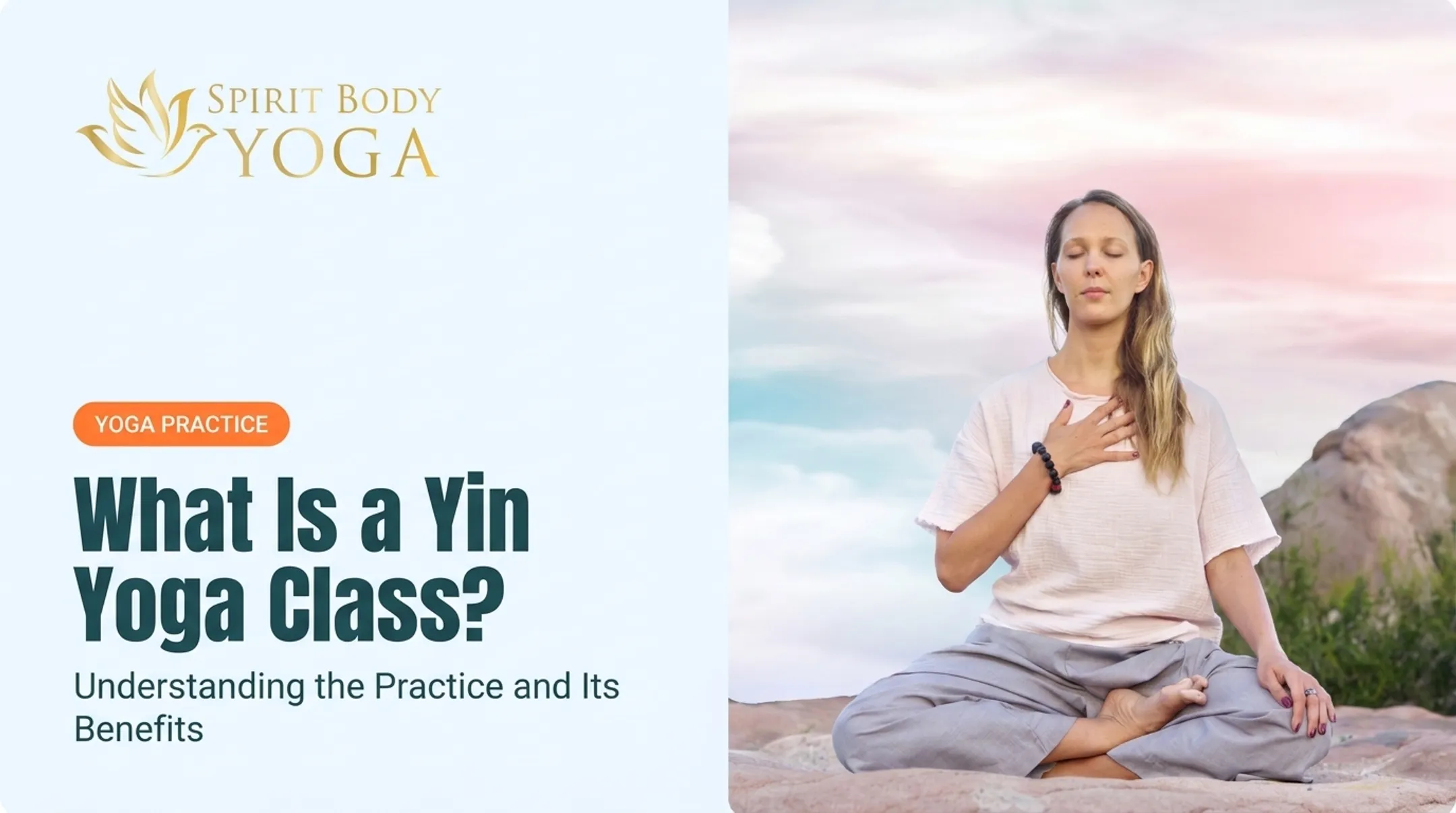
What Is Yin Yoga?
Yin Yoga is a meditative practice that targets deep connective tissue rather than muscle. It grew out of Taoist and Hatha influences, developed by Paulie Zink and later shaped by teachers like Paul Grilley and Sarah Powers, who blended anatomy and meridian theory into the modern practice (YinYoga.com).
It sits in contrast to "Yang" styles (Vinyasa, Power Yoga), which build heat and work muscles through movement.
The Three Core Principles
Yin practice follows a simple framework:
- Find your edge — a noticeable stretch, never pain
- Be still — in body, breath, and mind
- Hold the pose — typically 3-5 minutes, sometimes longer

Why Cold Muscles Matter
Unlike Vinyasa, Yin isn't practiced after a warm-up. You stretch on cold muscles so the gentle stress reaches fascia and ligaments instead of muscle tissue.
A 2024 randomized study found that a single 5-minute static stretch reduced both muscle and deep-fascia stiffness, while dynamic stretching did not. That supports the idea that sustained, still holds work differently than active movement (PMC, 2024).
Yin is as much mental training as physical work. Sitting in stillness for minutes at a time teaches you to tolerate discomfort without reacting, a skill that outlasts the mat.
How Is Yin Yoga Different From Other Yoga Styles?
Yin vs. Vinyasa/Power Yoga
Vinyasa links breath to movement, flowing from pose to pose and building muscular heat. Yin does the opposite: it's passive, still, and slow, working connective tissue rather than muscle strength.
A 2022 study compared five exercise conditions in adults with anxiety and depression. It found measurable cardiovascular changes with aerobic exercise and Vinyasa, but not with static Yin practice (ScienceDirect, 2022). That doesn’t diminish Yin; the styles simply serve different purposes.
Yin vs. Restorative Yoga
People often mix these up. Here's the distinction:
| Aspect | Yin Yoga | Restorative Yoga |
|---|---|---|
| Sensation | Mild stretch at the joint's edge | No stretch: full support |
| Typical hold | 3–5 minutes | 10–20 minutes |
| Goal | Condition connective tissue | Total rest and relaxation |

Both belong in a well-rounded routine. Spirit Body Yoga's on-demand library includes gentle, restorative, Yin, and Vinyasa formats, so members can mix and match depending on what their body needs that day.
What Does Yin Yoga Do to Your Body? (Benefits)
Yin Yoga works on connective tissue, the nervous system, and mental habits through long, passive holds. Research and practice point to several consistent benefits:
Flexibility and joint mobility. A 2025 randomized trial of 24 women found six weeks of twice-weekly Yin practice produced positive flexibility outcomes, though the study was small and not double-blinded (Journal of Orthopedics Research and Rehabilitation, 2025).
Stress and emotional regulation. A 2018 randomized controlled trial of 105 stressed adults found that five weeks of Yin Yoga reduced anxiety and sleep problems compared to a control group. Participants who combined Yin with mindfulness education saw the biggest drop in stress and depression scores (PLOS ONE, 2018).
Mental resilience. Holding a pose past the point of comfort (without escaping it) builds patience. That quiet work is central to Yin: staying with sensation rather than avoiding it.
Bone and joint support. Sustained gentle stress on joints like the hips and spine may support long-term joint health, though broader yoga research speaks to this more directly than Yin-specific studies do.
These outcomes align with Spirit Body Yoga's whole-person approach: practices that calm the mind, release physical tension, and support the body without forcing it.
Getting Started With Yin Yoga as a Beginner
Yes, beginners can do Yin Yoga. No flexibility, strength, or prior yoga experience required. The practice is built around meeting your body exactly where it is.
What to Have on Hand
- Mat — your base for seated and reclined poses
- Blocks — raise the floor to meet you in forward folds
- Bolster — supports the torso or knees in relaxed positions
- Blanket — adds warmth (your body cools during long, still holds) or padding
- Strap — extends your reach without forcing a stretch
Props aren't a crutch. They're what let you settle into a pose without overextending.

What a First Class Feels Like
Expect an opening settle-in, several held poses with brief transitions between them, and a longer savasana at the end. Stillness, not movement, is the whole point. That’s why many beginners find it harder than a fast-paced flow class.
A few practical tips:
- Eat light beforehand; a heavy stomach makes long seated holds uncomfortable
- Dress in layers since your body temperature drops during stillness
- Go in expecting your mind to wander — that's normal, not failure
When you’re ready to try a class, Spirit Body Yoga’s membership gives you unlimited on-demand access instead of a fixed weekly schedule. Start with one Yin class and build from there, pairing it with more active Vinyasa sessions as your practice grows. The $29/month membership includes a 7-day free trial, so beginners can try Yin from home before committing.
Simple Beginner-Friendly Yin Poses to Try
These four poses make a gentle first Yin session and hit the areas beginners usually feel tightest:
- Child's Pose — Stretches the back, hips, and thighs. Hold 3–5 minutes with a blanket or bolster under your forehead.
- Butterfly Pose — Bring the soles of the feet together and fold forward. Targets the hips and lower spine; hold 3–5 minutes.
- Reclined Twist — Drop both knees to one side and open the arms wide. Releases the spine and shoulders; hold 3–5 minutes each side and support the knees if you feel strain.
- Supported Savasana — Close with full relaxation. Rest 6–10 minutes with a bolster under the knees.

Stretch only to a mild sensation, never pain. Use props freely; skipping them is not a badge of honor.
A guided class—live-streamed or on-demand—is still the easiest way to learn pacing and form. Spirit Body Yoga's on-demand Yin and gentle classes give you an instructor-led start so you are not timing holds alone.
Frequently Asked Questions
Can you do yin yoga as a beginner?
Yes. No flexibility or prior experience is required. Props and modifications make every pose accessible from your very first session.
What does yin yoga do to your body?
It improves joint mobility and connective tissue health through slow, sustained holds. It also supports stress reduction and emotional resilience.
How is yin yoga different from other yoga?
Yin uses passive, long-held floor poses targeting connective tissue. Styles like Vinyasa or Hatha involve more movement and active muscle engagement.
What should I wear to a yin yoga class?
Comfortable, non-restrictive layers work best. Your body temperature drops during long, still holds, so having something warm nearby helps.
How long should you hold a yin yoga pose?
Typically 3-5 minutes. Beginners can start with shorter 1-2 minute holds and build up as comfort increases.
Is yin yoga a good workout?
Not in the cardiovascular sense. It's a recovery-focused practice best paired with more active exercise, like Vinyasa or strength training.