Ancient Wisdom That Draws You Closer to God
“. . . I hope all is well with you and that you are as healthy in body as you are strong in spirit.”
— 3 John 2 (NLT)
There is a longing many of us carry, whether we can name it or not, there is this desire to feel whole. Not just strong in body, or steady in mind, or deeply anchored in spirit, but a desire to live healthy in ALL areas of who we are. To experience true wholeness. This is the heart behind every practice we offer inside Spirit Body Yoga: not performance, not perfection, but wholeness.
At Spirit Body Yoga, we are not chasing perfection. We are building a steady, rooted life. One that strengthens the body, nourishes the spirit, and keeps us anchored in God’s presence.
When we begin to explore yoga beyond movement, we discover that it was never meant to be just physical exercise. Yoga was originally outlined as a pathway of transformation, a framework designed to guide a person toward alignment, clarity, and ultimately, union with God.
To understand yoga in its fullness, we have to go back to its origin as a spiritual framework.
It’s important to understand the original structure of these teachings and that their purpose was to shape the whole person in body, mind, and spirit, toward a life of awareness, discipline, and divine connection.
A Brief History of the Eight Limbs
Long before yoga became what we see in modern studios today, it was part of an ancient system of spiritual formation in India. These teachings were preserved and organized by a sage named Patanjali, who is believed to have lived somewhere between 200 BCE and 400 CE. He did not create the yogic path, but simply wrote down the practice as it had been verbally taught for thousands of years before.
So, rather than creating something entirely new, Patanjali gathered existing oral traditions and practices and compiled them into a text known as the Yoga Sutras. This text became one of the most foundational guides for understanding yoga as a path of inner transformation and enlightenment.
At that time, yoga was not centered on physical postures as it is today in western culture. The focus was on stilling the mind, disciplining the body, withdrawing from the world, and cultivating awareness so that a person could experience deep spiritual connection.
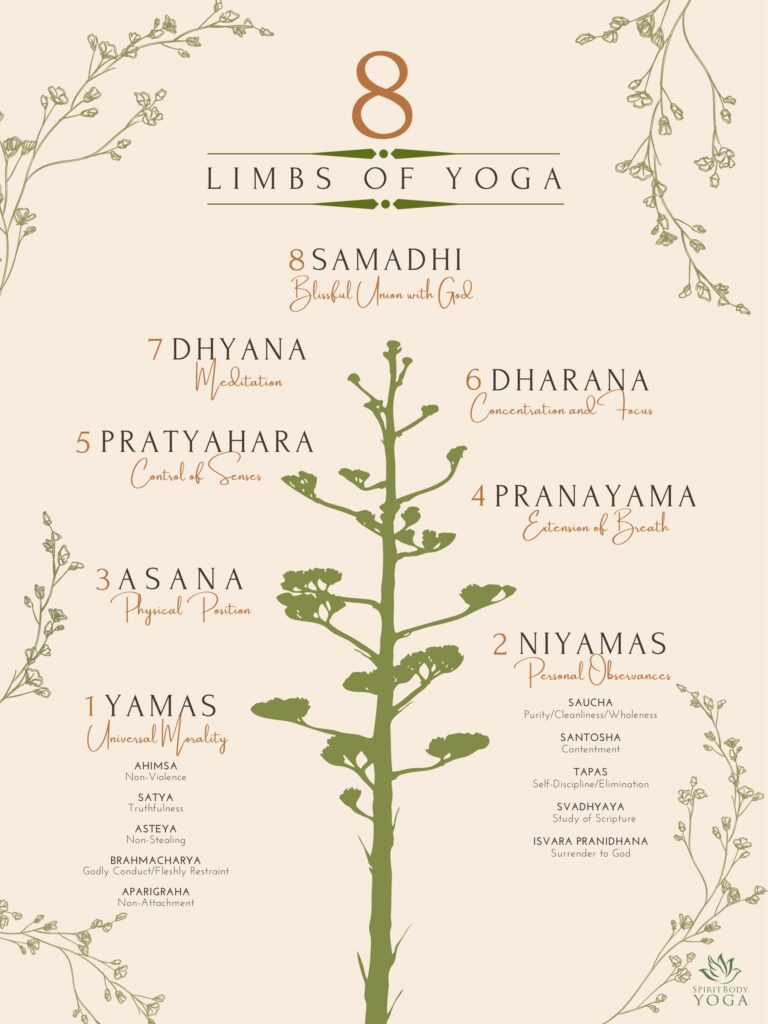
Within the Yoga Sutras, Patanjali outlined what is known as the Eight Limbs of Yoga, often described as a tree. Each limb supports the others. Each one matters. And together, they form a life rooted in intention, discipline, surrender, and connection. These limbs were not meant to be followed in strict order like a checklist. They were designed to work together, like parts of a living tree, each supporting the growth of the whole person.
The purpose was clear. To guide individuals toward clarity, self-control, spiritual awareness, and ultimately, union with the Divine.
The 8 Limbed Path teaches stilling the mind, disciplining the body, withdrawing from the world, and cultivating awareness so that a person can experience deep spiritual connection.
What is Yoga?
Some people believe that yoga is a religion, but at its core, yoga is a series of introspective principles designed to draw a person closer to God.
These ancient principles echo truths we find throughout Scripture. They shape how we live, how we think, how we move, and how we surrender.
The word Yoga comes from the Sanskrit root Yuj, meaning “to join,” “to yoke,” or “to unite.” As Christians, this aligns deeply with our desire to live in relationship with God, uniting with the Father, the Son, and the Holy Spirit.
“Come to Me, all you who labor and are heavy laden, and I will give you rest. Take My yoke upon you and learn from Me, for I am gentle and lowly in heart, and you will find rest for your souls. For My yoke is easy and My burden is light.” ~ Matthew 11:28-30
Jesus spoke of this kind of union when He prayed:
“I do not pray for these alone, but also for those who will believe in Me through their word; that they all may be one, as You, Father, are in Me, and I in You; that they also may be one in Us…” ~ John 17:20–23
The Eight Limbs of the Yoga Tree
Each limb reflects a different aspect of a life that is being formed and refined. The first two limbs, Yamas and Niyamas, provide practical ways to live this out daily. They shape both our outward actions and our inward posture. Below you will find the 8-Limb Path laid out with a definition and a scripture referring to that principle found in the Bible. Although these principle are found in many places on the Bible I quote a single scripture for each and I chose to line up the Yamas with the 10 Commandments (Universal Morality).
1. YAMAS (Universal Morality)
- Ahimsa (Non-Violence)
A call to live gently, choosing love over harm in thought, word, and action.
“You shall not murder.”
~ Exodus 20:13 - Satya (Truthfulness)
An invitation to walk in honesty and integrity, reflecting God’s truth in all we do.
“You shall not bear false witness against your neighbor.”
~ Exodus 20:16 - Asteya (Non-Stealing)
A posture of respect and trust, honoring what belongs to others.
“You shall not steal.”
~ Exodus 20:15 - Brahmacharya (Godly Conduct and Restraint)
A life of self-control and purity, honoring God with our bodies and choices.
“You shall not commit adultery.”
~ Exodus 20:14 - Aparigraha (Non-Attachment and Non-possessiveness)
To let go of excessive attachments and desires to things of the world (materialism).
“You shall have no other gods before Me.”
“You shall not covet . . .”
~ Exodus 20:3, 17
2. NIYAMAS (Personal Observances)
- Saucha(Purity, Cleanliness, and Wholeness)
A commitment to inner and outer cleanliness.
“Therefore if anyone cleanses himself . . . he will be a vessel for honor, sanctified and useful for the Master, prepared for every good work.”
~ 2 Timothy 2:21 - Santosha (Contentment)
A state of inner peace and acceptance of one’s circumstances, free from cravings and desires.
“Not that I speak in regard to need, for I have learned in whatever state I am, to be content: I know how to be abased, and I know how to abound. Everywhere and in all things I have learned both to be full and to be hungry, both to abound and to suffer need. I can do all things through Christ who strengthens me.”
~ Philippians 4:11–13 - Tapas (Fiery Discipline and Refinement)
The spiritual heat of transformation. It’s the intensity of discipline and removal that is required to create necessary change in our lives.
“Every branch in Me that does not bear fruit He takes away; and every branch that bears fruit He prunes, that it may bear more fruit.”
~ John 15:2 - Svadhyaya (Study and Reflection in Scripture)
Sacred exploration of ourselves through reflection, study of scripture, and contemplation.
“This Book of the Law shall not depart from your mouth, but you shall meditate in it day and night, that you may observe to do according to all that is written in it. For then you will make your way prosperous, and then you will have good success.”
~ Joshua 1:8 - Ishvara Pranidhana (Surrender to God)
The practice of total devotion, surrender, and complete submission to God.
“Then Jesus said to His disciples, ‘If anyone desires to come after Me, let him deny himself, and take up his cross, and follow Me. For whoever desires to save his life will lose it, but whoever loses his life for My sake will find it.’”
~Matthew 16:24–25
3. Asana (Physical Posture)
- To keep the physical body healthy and strong. Looking after the physical body is vital for spiritual development.
“Or do you not know that your body is the temple of the Holy Spirit who is in you, whom you have from God, and you are not your own? For you were bought at a price; therefore glorify God in your body and in your spirit, which are God’s.”
~ 1 Corinthians 6:19-20
4. Pranayama (Breath / Life Force Control)
- Breathing practices used to promote physical, mental, emotional, and spiritual well-being.
“The Spirit of God has made me, and the breath of the Almighty gives me life.”
~ Job 33:4
5. Pratyahara (Withdrawal of the Senses)
- Controlling the pull of sensory stimuli so that the mind can turn inward and focus on deeper awareness.
”So I say, walk by the Spirit, and you will not gratify the desires of the flesh. For the flesh desires what is contrary to the Spirit, and the Spirit what is contrary to the flesh. They are in conflict with each other.”
~ Galatians 5:16-17
6. Dharana (Concentration)
- A state of mental concentration on an object without wavering.
“Finally, brethren, whatever things are true, whatever things are noble, whatever things are just, whatever things are pure, whatever things are lovely, whatever things are of good report… meditate on these things.”
~ Philippians 4:8
7. Dhyana (Meditation)
- To think deeply and contemplate on a certain thought or idea.
“Let the words of my mouth and the meditation of my heart be acceptable in Your sight, O Lord, my strength and my Redeemer.”
~ Psalm 19:14
8. Samadhi (Union / Oneness)
- Bliss. Fully connected to God.
“I am the vine, you are the branches. He who abides in Me, and I in him, bears much fruit; for without Me you can do nothing.”
~ John 15:5
FREE DIGITAL POSTER
Bringing It All Together
When we begin to see the Eight Limbs through a faith-centered lens, we recognize something powerful. These are not just ancient ideas, they are patterns of living that align with a life devoted to God, and each Limb (principle) is found in the Bible.
Just like Christianity, Yoga is not about striving or achieving. It is about surrender, connection, awareness, and a call to live deeper, better, and more alive. Becoming who were were create to be and knowing the One who created us.
Yoga is learning to let your body become a place of worship.
To let your breath remind you that you are sustained, never alone.
To let your life reflect the One you are connected to.
Yoga is the invitation. To build a steady practice that strengthens your body, anchors your spirit, and draws you closer to God, one breath and one moment at a time. The Eight Limb Path is a constant reminder that there is more to this finite life than what we see, and we should be reaching for the infinite, the eternal. The ancient sages knew this, and Patanjali wanted this path of seeking union with the Divine, to be available to everyone. And so does God. God is available to each of us if we are actively seeking.
“Ask, and it will be given to you; seek, and you will find; knock, and it will be opened to you.” ~ Matthew 7:7
This is part of Jesus’ teaching on trusting God and actively pursuing Him.
If this resonates with you, continue the journey with me through the Spirit Body Yoga Podcast and inside our practice space at SpiritBodyYoga.com. We exist to help you build a steady daily practice that strengthens your body, anchors your spirit, and draws you closer to God one breath, one movement, one moment at a time. Also, you can download our FREE Spirit Body Yoga APP to get daily inspiration delivered right to your device!

Leave a Reply